
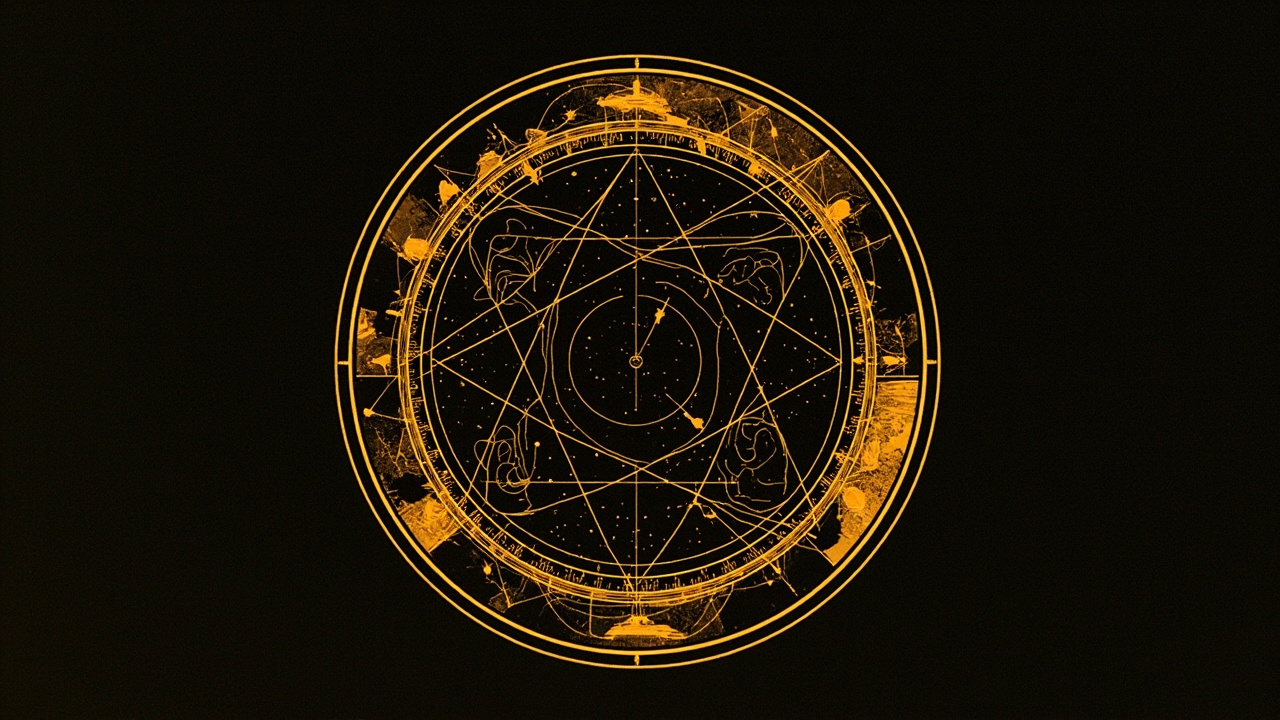
Your Human Design chart is a split map. On one side lives everything you can see about yourself — your personality, your style, your gifts, the roles you play.
The Difference Between Your Conscious and Unconscious Self
Your Human Design chart is a split map. On one side lives everything you can see about yourself — your personality, your style, your gifts, the roles you play. On the other side lives everything that runs you from behind the curtain — the quieter intelligence of your body, the patterns you didn't choose but inherited, the way life seems to move through you without your permission.
These are the two sides of the bodygraph: the Personality and the Design. The conscious and the unconscious. The black and the red.
Two Halves of the Same Chart
Look at any bodygraph and you'll see that every planet, every gate, every center has two symbols — one filled in black, one filled in red. The black side is your Personality, the conscious layer. The red side is your Design, the unconscious layer.
The Personality side is the one you recognize. It's how you describe yourself at a dinner party. It's the way you approach people, the language you use, the way you dress. If you have, say, a defined Throat on the black side with the Gate of Expression activated, you're likely someone who knows they like to talk, who has thought about how they communicate, who has an opinion about their own voice. That's conscious territory. You can see it.
Curious if this is in YOUR chart? Calculate your free Human Design.
Calculate your chartThe Design side is stranger. It's the part of you that operates before you have a thought. It's the part that knows things you didn't decide to know. If a center or gate shows up only in red, you may not even recognize it as yours — until life keeps bringing you back to the same theme, over and over, like a song you can't stop humming.
The 88 Days Before You Were Born
This split isn't metaphorical. In Human Design, the Design side of your chart is calculated from the planetary positions exactly 88 days (about three months) before your birth. This is the moment your body — your vehicle for this life — was forming. The Design is sometimes called your "incarnation cross from before incarnation," the imprint of how you entered form.
The Personality, by contrast, is calculated from your actual birth moment — the instant you took your first breath and became a being with a personality, a name, a story, a life.
So when you read your chart, you're really reading two moments layered on top of each other. The moment your body was prepared. And the moment you showed up to use it.
This is why the two sides can feel so different. They are different. One is who you are becoming. The other is what was always there, waiting.
How They Show Up in Your Life
The conscious side of you is what you've been collecting opinions about your whole life. Your Type, your Strategy, your Authority — these belong mostly to the conscious layer. When you learn your Type, you feel recognition, like someone finally described the thing you always knew. That's the Personality saying, Yes, that is me. I have known that about myself.
The unconscious side is the one that surprises you. It's your conditioned patterns, the body-level reactions, the way you keep ending up in the same kind of relationship or the same kind of job even when you swear you've changed. It's the part of you that operates through the body's wisdom — through the solar plexus, the spleen, the sacral — and it doesn't care about your opinions. It just keeps doing its thing.
A defined Gate on the black side might show up as a conscious skill or interest. A defined Gate on the red side might show up as a quiet, almost magnetic pull. People feel it more than you do. It draws them toward you, or it creates a particular kind of friction in your life, depending on the channel it's part of.
The Channel Between
Every channel in the bodygraph — those lines connecting two centers — is made of one black gate and one red gate. The black gate is what you're meant to become conscious of. The red gate is what your body already knows. Together, they form a complete energetic bridge.
When the channel is fully integrated, the conscious and unconscious sides communicate. You feel your body's wisdom rise up into your awareness. You think a thought, and your body confirms or denies it. This is what Human Design means when it talks about living in alignment — not forcing your personality onto your design, but letting the two sides talk to each other.
When the channel is split — when only one gate is defined and the other is open — there's a different dynamic. You might be deeply aware of one quality and completely unconscious of the other. You might have the conscious capacity but lack the body's natural support, or you might have a body-level gift that you can't quite bring into language.
Living With Both
Working with your conscious side is about awareness. It's about learning the language of your chart and recognizing the patterns that show up in your daily choices. This is where observation helps — noticing how you respond, what you say yes to, what depletes you.
Working with your unconscious side is about trust. You don't have to know what's happening in your Design for it to operate correctly. In fact, trying to figure it out with your mind can interrupt it. The unconscious side is felt, not thought. It's a sensation, a pull, a quiet "no" in the chest. It's the part of you that knew something was off three years before you had the words to explain it.
Most of us are taught to live mostly from consciousness — to think, plan, decide. Human Design asks you to include the unconscious too. To let your body's wisdom speak, even when you can't name it yet. To trust that the red side of the chart is doing its job, even when you can't see how.
The conscious and the unconscious are not enemies. They're not at war. They're two halves of a single whole, asking to be lived together. The more you stop choosing between them, the more the chart becomes what it always was — a quiet description of how you actually work, waiting patiently for you to find your way back to it.