

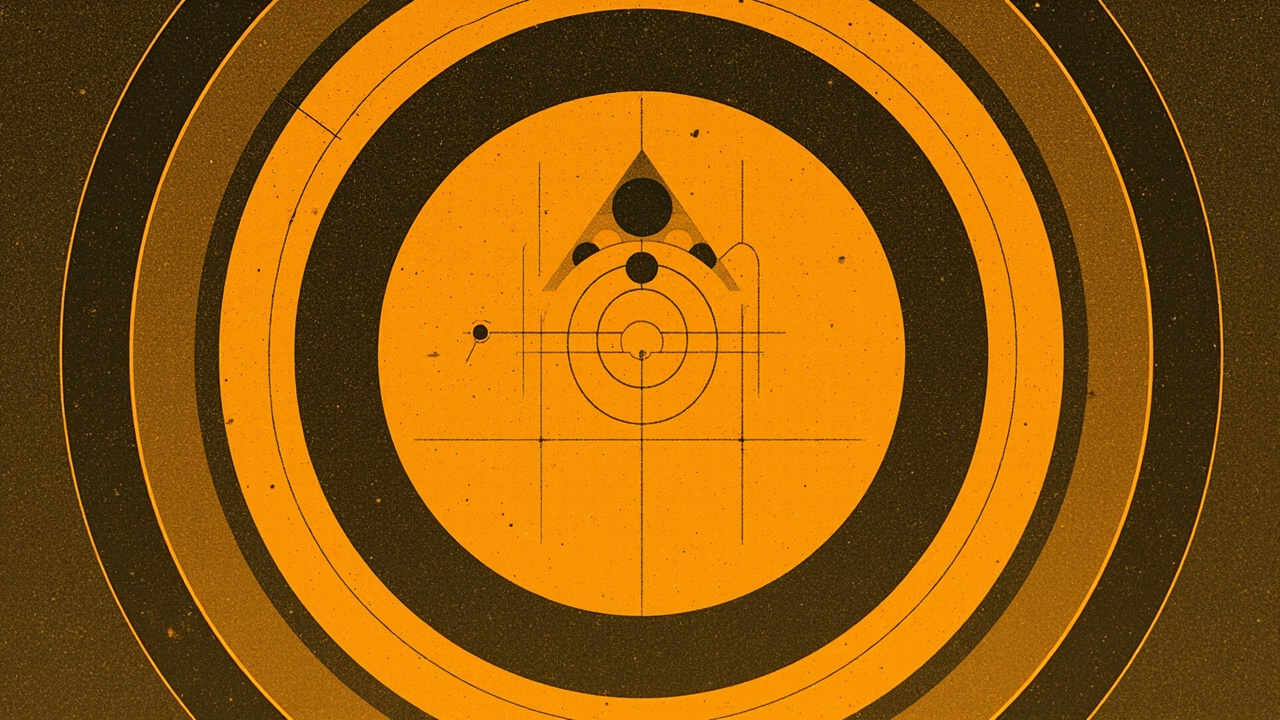
Hexagram 52 'Keeping Still' in the I Ching. One of 64 archetypes underlying Human Design.
Hexagram 52: Keeping Still — The Mountain's Wisdom
Hexagram 52, Keeping Still (艮, Gèn), is one of the most quietly powerful configurations in the I Ching. It is composed of the trigram Gen (Mountain) doubled — stillness over stillness, as if a mountain has risen behind another mountain, the world hushed and held in place. The classical text gives a remarkably short judgment: "Keeping still. Keeping his back still so that he no longer feels his body. He goes into his courtyard and does not see his wife. No blame." The image seems austere, almost cold, yet the teaching is profoundly practical. It is not about withdrawal or apathy; it is about the discipline of stopping at the right moment, in the right way, for the right reason.
The Mountain as a Teacher
A mountain does not chase, negotiate, or hurry. It simply stands. The doubled trigram in Hexagram 52 does not, however, praise stubbornness. The commentary is emphatic that stillness is only correct when it corresponds to the time (shí). If the moment calls for movement, then the one who keeps still has misread the situation. This is the core paradox: knowing when not to act is the same skill as knowing when to act, and both require an honest reading of conditions, not a preference for being either still or moving.
In Human Design, this hexagram becomes Gate 52, the Gate of Stillness, sitting at the Root Center when connected to Gate 9 in the Channel of Awareness. Its energy is contemplative and evaluative. It asks, is this mine to focus on, or is this noise? The body tends to register this as a kind of gravitational pull toward quiet — a narrowing, a sense that something is not for you.
The Body as a Map of Stillness
What makes Hexagram 52 unusually vivid is that it places stillness in specific parts of the body, ascending line by line:
- Initial Nine — the toes. Stillness begins before it is felt in the heart. You stop early, instinctively, before the impulse has fully formed. The advice is to halt the thought before it moves the body.
- Six in the second — the calves. Restless stillness. The mind has committed to stopping, but the body hasn't caught up. The calf muscles tremble when the person tries to remain still; "this is called wobbling." A warning that intellectual restraint without groundedness brings misfortune.
- Nine in the third — the hips. Stillness imposed on the will. The hips, where movement originates, are held rigid. If the heart cannot follow the body's stop, the body will eventually betray it.
- Six in the fourth — the trunk. Stillness at the core. Here at last, the body and the will are in agreement. "No blame." This is the true center of gravity.
- Nine in the fifth — the jaw. Stillness in speech. The mouth is still because the words inside are ordered. There is nothing to add.
- Nine at the top — simplified stillness. "Keeping still in the wrong way" — rigidity mistaken for wisdom, the kind of silence that is actually stubbornness or fear.
The line-by-line progression is essentially a practice. Real stillness moves from the periphery (toes) to the core (trunk), and from there radiates outward into the right words. Skipping the trunk produces a brittle, defended silence rather than a generative one.
Stillness Is Not Withdrawal
The most common misreading of Hexagram 52 is to treat it as instruction to withdraw from life. The image of not seeing one's wife in the courtyard is deliberately unsettling. The courtyard is one's own domain; the wife is one's closest companion. The point is not that keeping still leads to isolation, but that when stillness is correct, the outer world recedes on its own. You do not have to announce it, defend it, or use it to punish others. It is simply that the right action has not yet ripened, and the wise one waits.
The shadow of this hexagram appears in three forms. First, stillness as avoidance — a polite name for cowardice. Second, stillness as rigidity — a refusal to move because the ego has chosen its position. Third, stillness as spiritual bypassing — using composure to bypass real feeling, real conflict, real work. True stillness has substance behind it; it can be tested and it does not break.
Practicing the Mountain
In practical terms, Hexagram 52 invites a daily practice of right stopping. Before acting, ask whether the impulse is arising from a quiet center or from anxiety. In conversation, let there be a pause that is not an absence but a presence. In decisions, prefer the lower line, the lower part of the body — feel into the trunk before you move the lips.
The mountain does not need to defend its height. It does not explain why it stands. The work of Hexagram 52 is to develop that same unforced presence: still, not because you have forced yourself, but because the time has not yet come to move — and when it does, you will move without hesitation.