


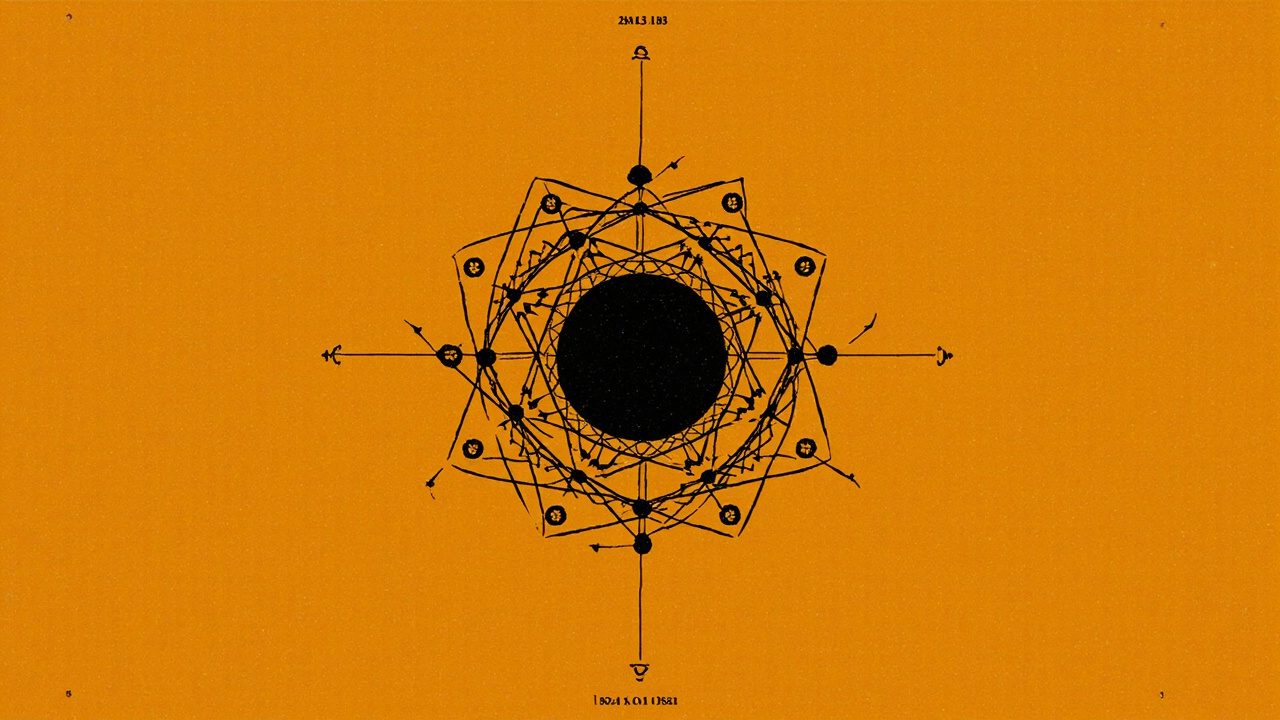
Hexagram 50 'The Caldron' in the I Ching. One of 64 archetypes underlying Human Design.
Hexagram 50: The Caldron
A Vessel of Transformation
The Caldron (鼎, Dǐng) is one of the most evocative images in the I Ching. Picture a bronze tripod vessel set over an open fire: wood beneath, flame rising, the contents slowly turning from raw and separate into something nourishing and whole. Hexagram 50 captures this moment of refining, when the scattered raw materials of life are gathered into a sacred container and cooked into culture itself.
The hexagram speaks to any situation in which something must be held, heated, and transformed. It governs cooking in the deepest sense — the turning of raw experience into wisdom, of talent into craft, of conflict into community. Wherever a great cauldron stands, the smell of change is in the air.
The Structure: Fire Above, Wood Below
Above sits Li (Fire), the clinging flame — visible, bright, drawing all eyes. Below rests Xun (Wind/Wood), the gentle penetration — yielding, branching, the fuel. The composition is Fire over Wood, but in a domestic, sustainable form: not wildfire consuming a forest, but the controlled hearth that feeds a household. The image is a working cookfire, the engine of civilization.
Wood ascending into fire represents the perfect union of effort and inspiration: labor feeding vision, vision ennobling labor. When these two are properly aligned, nothing is wasted. Every branch becomes part of the meal.
The Judgment: Supreme Good Fortune
The Wen Yan (ten thousand words commentary) is unusually direct. The Caldron is pronounced "supreme good fortune." The vessel of nourishment is itself the image of flourishing. To stand inside a cauldron situation is to be in the heat of something that, if properly held, will produce lasting good.
The text specifically names the Duke of Zhou casting the cauldron as a sign of receiving and feeding the worthy. In ancient China, possession of the nine-tipped imperial ding legitimized a dynasty; whoever held the vessel held the mandate to nourish the people. Today, the modern equivalent is the institution, the practice, the role, the body of work through which you feed others and through which your own gifts are concentrated.
Line by Line: The Stages of the Cook
The six lines trace the arc of a complete transformation:
- Line 9 (top): The handle of jade — perfect form, perfect purpose. Excellence without ostentation.
- Line 8: A cauldron with a missing leg — authority without support; a position that lacks foundation.
- Line 7: A cauldron with handle and ears, the rings unmoved — readiness without motion; potential waiting for the right moment.
- Line 6: A cauldron filled with food, the handles bent toward the user — nourishment drawn toward you, generosity repaid.
- Line 5: The cauldron has yellow ears and golden rings — bright virtue visibly manifested, one's work shining through.
- Line 4: The cauldron's feet are overturned — proper order has been disturbed; judgment that once stood has fallen.
- Line 3: The cauldron's handle is cut off — the channel of support removed; you can no longer reach the public.
- Line 2: The cauldron is full — the vessel cannot yet receive more; cultivate patience.
- Line 1 (bottom): The caldron is overturned, but the handles are intact — the foundation holds even when purpose is interrupted; a moment of reversal that will pass.
The Practical Reading
When Hexagram 50 shows up, ask three questions. What is the vessel? — what structure, practice, or role is doing the holding? What is being cooked? — what raw material of your life is now being refined? Who is being fed? — whose nourishment is the real measure of success?
The cauldron does not judge by speed or by noise. It judges by what comes out. A cauldron situation rewards patience, proper materials, and the discipline of tending a slow fire.
The Shadow: Burnt Offerings
Every great vessel has its shadow. A cauldron can scorch what it receives, or cook for itself alone. The shadow side of Hexagram 50 is the closed kitchen: prestige that no longer nourishes, authority that broods over its own rituals, craft that has forgotten the eater. When the fire is hot but no one is fed, the vessel becomes a prison of refinement.
The warning in the changing lines about overturned feet and missing handles is not about failure but about a misalignment of structure and purpose. Form without function is the cauldron of vanity.
Modern Applications
Hexagram 50 belongs to founders shaping a practice, teachers building a curriculum, parents raising a family, leaders in their first years of holding office. It also belongs to anyone undergoing an alchemical season — illness turning to health, apprenticeship turning to mastery, grief turning to meaning.
Stand near the fire. Stir what is yours. Feed those you are meant to feed. The cauldron holds.