


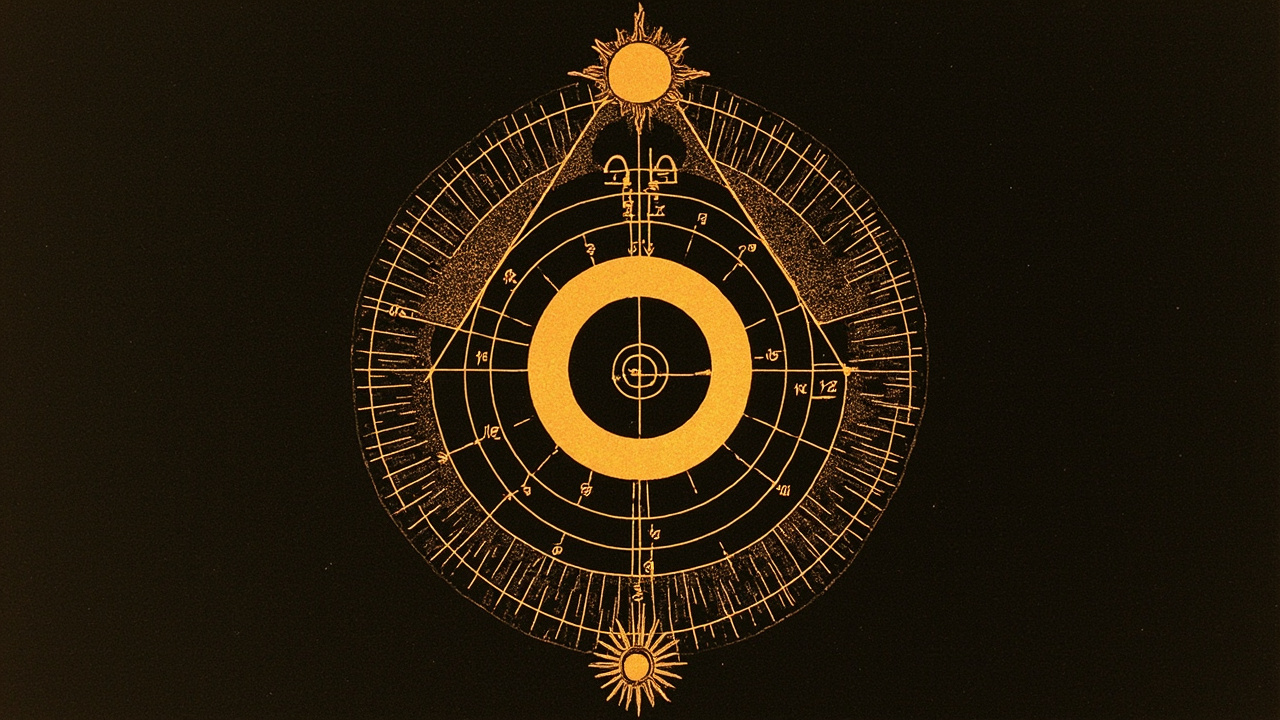
Hexagram 30 'The Clinging Fire' in the I Ching. One of 64 archetypes underlying Human Design.
Hexagram 30: The Clinging Fire
Hexagram 30 is one of the I Ching's most striking images—two trigrams of pure fire stacked one above the other, blazing across the hexagram's field. Its name, Li (離), is usually translated as "The Clinging" or simply "Fire," and both meanings matter. The character itself depicts something that clings, separates, and illuminates all at once: a flame fastened to wood, a brightness that needs fuel, an awareness that depends on what it fastens to.
The Symbol: Double Fire
The upper and lower trigrams are identical—Li over Li, fire on fire. But the trigrams are not the same fire. The lower trigram is the flame in the hearth, intimate, domestic, close to the ground. The upper trigram is the fire of the sun, the lightning, the distant blaze that lights the heavens. Together they describe a single principle seen at two scales: inner clarity and outer illumination, the small light kindled from a larger one.
Fire, in the I Ching's psychology, is associated with the eye, with seeing, with consciousness itself. Hexagram 30 is therefore the hexagram of vision, awareness, and culture—the brightness that humans add to the world by paying attention.
The Clinging Principle
The name Li is not only "fire." It is fire that clings. A flame must attach itself to something—wood, oil, a wick, a greater blaze—in order to exist. Nothing burns in isolation. The hexagram therefore asks an essential question: what are you clinging to, and what is clinging to you?
Healthy clinging fastens itself to principle, to craft, to people and practices that feed the light. The scholar clings to discipline. The artist clings to form. The seeker clings to a teacher or a tradition long enough to kindle their own flame. Unhealthy clinging is addiction, codependency, the burning up of self in a brightness that gives nothing back. The hexagram does not condemn attachment; it insists on it. The work is choosing what deserves your flame.
The Judgment: The Cow Brings Good Fortune
Wilhelm's translation of the Judgment is famous for its strangeness: "Perseverance furthers. It brings success. Care of the cow brings good fortune."
The cow is a deliberate counterweight to fire. Fire blazes upward, leaps, consumes, insists. The cow is docile, grounded, accepting, going where it is led. When the hexagram counsels "care of the cow," it is telling the fiery soul to soften—let bright