


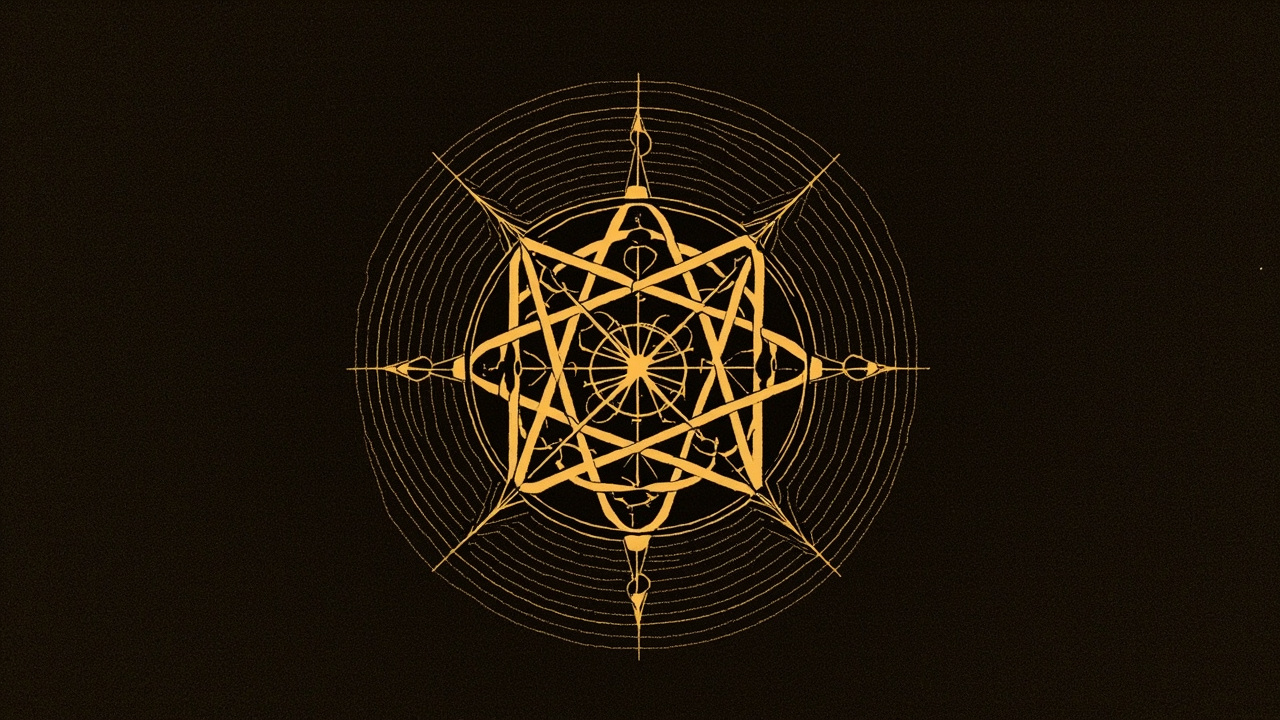
Juxtaposition Cross of Cross of Experience: theme "Progress". One of 192 incarnation crosses in Human Design.
Juxtaposition Cross of Cross of Experience — Human Design
Some Incarnation Crosses come with a quiet theme. The Juxtaposition Cross of Cross of Experience is not one of them. It arrives as a life that insists on meeting itself from every possible angle, a personality that learns only by colliding with what it is not.
Where This Cross Lives in the System
The Cross of Cross of Experience sits inside the Right Angle Crosses of the Juxtaposition Quarter — the quarter of duality in the Human Design mandala, the domain where ignorance and knowledge are deliberately placed on the same shelf. It is powered by a single defining channel, the 44–26 Channel of Transitoriness, which threads the Splenic Center into the Heart/Ego Center. The mechanics of this cross are simple, but the chemistry is volatile. Gate 44 at the spleen carries ancient, instinctive patterns — sometimes protective, sometimes outdated, always whispering about the past. Gate 26 at the ego is the storyteller, the proud transmitter, the voice that wants to be heard. When you weld those two together and then ask the personality to live them as a cross of crosses, you get a person who is essentially a meeting ground.
Curious if this is in YOUR chart? Calculate your free Human Design.
Calculate your chartThe Core Theme: Experience Itself as the Curriculum
This is the only Incarnation Cross whose name gestures at the whole category. Where most crosses zoom into a specific archetype — the Sphinx, the Vessel, the Plane — the Cross of Cross of Experience points at the mechanism of crossing itself. Life is the teacher, but not in a gentle way. The curriculum is the juxtaposition: the thing you are paired against, the contrast that defines you, the experience that can only be described by what came before or after it.
People with this cross tend to have lives that look, from the outside, like a series of scenes that don't quite cohere. Different geographies, different communities, different professions, different relationships that introduce a different version of self. This is not a design flaw. The point is to be the meeting place. The point is to stand in the middle of contradictions and notice what they reveal.
The Gifts of the Cross
When the 44–26 operates cleanly, the gifts are unusually specific:
- Pattern fluency. Gate 44's alertness combined with Gate 26's narration produces a person who can read a room, a history, or a life story with startling precision. They see how one chapter shadows another.
- Earned wisdom. This cross does not respect theory. Its authority comes from having been there. People with this incarnation often become informal teachers, mentors, or guides, not because they studied a curriculum, but because their lives have put them in rooms most people never enter.
- Magnetic storytelling. The 26 wants to transmit. When grounded in 44's instinctive knowing, the stories carry weight. They are not entertainment; they are containers for meaning.
- Capacity to hold paradox. Because juxtaposition is built into the design, these people can tolerate ambiguity, contradiction, and unresolved feelings longer than most. They are, by wiring, comfortable with not-knowing.
The Shadow Expressions
The shadow of this cross is the flip side of the gift, and it is sharp. When the 44–26 channel is unaligned, the very qualities that make the cross powerful become sources of confusion.
- Compulsive comparison. The juxtaposition starts to feel like a verdict. Every new experience is measured against another, and nothing is allowed to simply be.
- Storytelling as armor. Gate 26 can use narrative to keep people at a distance. The cross then becomes a life of carefully edited chapters instead of lived reality.
- Glamorized suffering. There is a particular trap here: treating difficult experience as a credential, or confusing intensity with depth. The spleen can grow addicted to the alert feeling, the body scanning for the next thing.
- Spiritual bypassing through breadth. Constantly crossing, traveling, comparing, and "experiencing" can become a way of never landing long enough to integrate anything.
Practical Guidance for Carriers
For someone carrying this cross, the experiment is not to seek more experience. The experiment is to be present in the one in front of you. A few concrete practices help:
1. Let the spleen complete its cycle. Gate 44 works on instantaneous intuitive intelligence. If you override it with mental justification, the awareness collapses into anxiety. Notice the first flash and trust it as data, not a directive.
2. Audit the storytelling. Gate 26 wants to transmit. Before you share a story, ask whether you are revealing something true or performing a version of yourself.
3. Choose a few juxtapositions and live them deeply. The cross does not require endless variety. It requires that you meet your contrasts honestly. Two or three deep crossings will teach you more than a hundred shallow ones.
4. Honor the transitoriness. The channel's name is not decorative. People, places, and phases will pass. Grief and gratitude are both correct responses.
Living the Cross of Cross of Experience
This is a cross that produces a person whose life, in retrospect, looks like a series of thresholds. Carriers often feel, in their quieter moments, that they have lived several lives in one. That feeling is accurate. The cross is not asking for a unified narrative. It is asking for an honest one — a life in which the crossings are not flattened into a single plot, but honored as the actual texture of being human.