


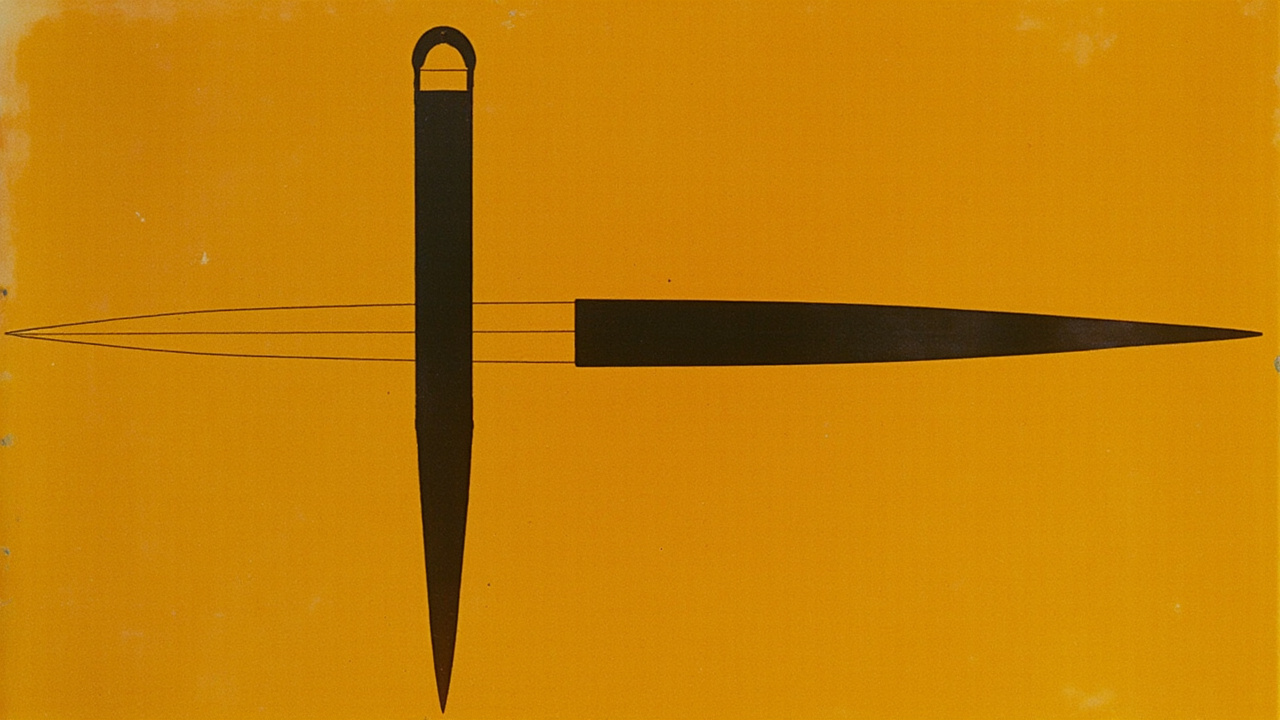
Juxtaposition Cross of Cross of Doubts: theme "Justification". One of 192 incarnation crosses in Human Design.
The Juxtaposition Cross of Cross of Doubts: The Sacred Questioner
There are Incarnation Crosses that whisper, and there are those that insist on a conversation. The Juxtaposition Cross of Cross of Doubts is firmly in the second category. It belongs to a small family of mental crosses in the Human Design system — designs built around the Head and Ajna centers, where the central human drama is not action, but the relentless refinement of perception. Those born under this cross are not here to provide answers. They are here to live the question so honestly that the question itself becomes a doorway.
The Architecture of Doubt
The Cross of Doubts is anchored in the channel of abstraction — Gates 63 and 64 — the only direct bridge between the Head Center and the Ajna Center. Gate 64, "Confusion Before Completion," carries the pressure to question everything in order to eventually clarify. Gate 63, "Doubt After Completion," tests every conclusion once it has been reached. Together they form a cyclic pressure: a hypothesis forms, gets doubted, dissolves into confusion, and the cycle begins again.
Curious if this is in YOUR chart? Calculate your free Human Design.
Calculate your chartIn the Juxtaposition form, the four activations of personality and design Sun and Earth all rest in these two gates. This is a concentrated mental signature. Where the Right Angle version of the cross spreads its energy across more centers, the Juxtaposition condenses it. The mind becomes a tuning fork, vibrating on a single, specific frequency of inquiry. People with this cross often report a sense that their life has been organized around a central question they keep returning to — about meaning, truth, belief, or the nature of reality itself.
The Gift: Conceptualization Through Doubt
At its highest expression, the Cross of Doubts produces some of the most incisive conceptual thinkers. The gift is not certainty — it is the willingness to be unfinished. Doubt, here, is a creative force. It refuses to accept the first plausible answer, the inherited belief, the comforting story. It is the force that drives genuine inquiry rather than the accumulation of opinions.
This cross often shows up in people who become philosophers, researchers, editors, troubleshooters, myth-breakers, and pattern-spotters. They can hold multiple contradictory ideas at once and not collapse into anxiety. The mental flexibility this produces is rare. Where others see a finished thing, a person with the Cross of Doubts sees the scaffolding, the assumptions, the invisible seams — and can describe what they see in a way that others find both disorienting and freeing.
The Shadow: Paralysis of Perpetual Questioning
The same energy, when unconscious, turns inward. Doubt that cannot find resolution becomes chronic suspicion — of self, of others, of every conclusion, including one's own. The person may loop endlessly in the Head Center, exhausting themselves and those around them. Decisions stall. Commitments feel premature. The wisdom of questioning becomes a prison of never-arriving.
A common shadow pattern is using doubt as a way to avoid risk. If nothing is ever certain, nothing is ever responsible. The person may also project their doubt onto others, becoming a relentless interrogator who confuses scrutiny with intimacy. There is a particular loneliness in this cross when it is unaware: a sense that no one thinks as carefully, no one sees as clearly, and therefore no one can be fully trusted as a companion in thought.
Living With This Cross
Practical guidance for this cross is unusually specific:
- Honor the timing of the cycle. Gate 64 confuses before clarity arrives. Gate 63 doubts after. Learn which phase you are in before forcing a conclusion. Some things genuinely require more time.
- Doubt as verb, not identity. You are not "a doubter." You are someone who doubts. The moment doubt becomes a fixed trait, the gift contracts into a posture.
- Pair the mind with a body practice. Mental designs need grounding. A regular physical discipline — movement, breath, hands-in-soil work — prevents the Head Center from running unopposed.
- Make decisions anyway. The cross is not asking you to be certain. It is asking you to act in the presence of uncertainty. Provisional action is the antidote to paralysis.
- Listen for the question behind the question. Often the doubt is not about the topic at all. It is about the search for a foundation that does not wobble. Naming that deeper need softens the loop.
The Evolutionary Invitation
The Cross of Doubts is a teaching cross. Its work is to model for the surrounding community what honest inquiry actually looks like — not cynicism, not relativism, but the disciplined willingness to keep thinking until the thought becomes true. In a world that rewards fast answers and confident opinions, this cross is the quiet reminder that some things are only found by those willing to remain uncertain long enough for the real answer to arrive.